
Start Bleckley County's Deed Timeline
Tracing former owners in Bleckley County means starting with the newest deed. Work back one transfer at a time from there. The GSCCCA Real Estate Index is the backbone of that property records search statewide. It indexes deeds by name, book and page, property, and plat. Per its official description, all-county deed transaction coverage runs from January 1, 1999 forward. Historical deed records from 1993 through 1998 are still being added. Anything older usually lives at the courthouse counter, in deed books, or on archival microfilm.
| Ownership source | Documented reach | Custodian | Best clue |
|---|---|---|---|
| GSCCCA deed index | All-county transactions from 1999; some older data | Clerk / GSCCCA | Grantor, grantee, instrument, book/page |
| Original deed books | Earlier county series | Clerk of Superior Court | Full instrument and legal description |
| County microfilm | Series shown by the county card | Georgia Archives | Older deed books, indexes, and tax digests |
| Probate vault | Records dating to 1875 | Bleckley Probate Court | Estate orders, wills, and distributions |
Former-owner research in Bleckley County starts with the latest deed and works backward. The GSCCCA Real Estate Index is the first stop. It offers statewide name, book/page, property, and plat paths. All-county deed coverage begins January 1, 1999. Its official description notes historical 1993 through 1998 data is still being added, and older links may require the courthouse counter, deed books, or archival microfilm.
Find Bleckley County's Current Grantee
Start from the newest deed in Bleckley County property records. That transfer names the current owner as grantee, the party who received title. Pull that deed first. Compare its legal description against the assessor card for the same parcel. A street address can shift meaning over decades. The land lot, district, acreage, subdivision, lot, and block stay stable across time.
The GSCCCA name search takes a party name, county, date range, and display settings. Limit it to Bleckley County at first. When results come up empty, try initials, alternate spellings, and exact entity punctuation. A neighboring-county option exists, though it can pull in unrelated names. Save it for a chain that truly leaves Bleckley. The official form also lets you display county data-good dates alongside each result.
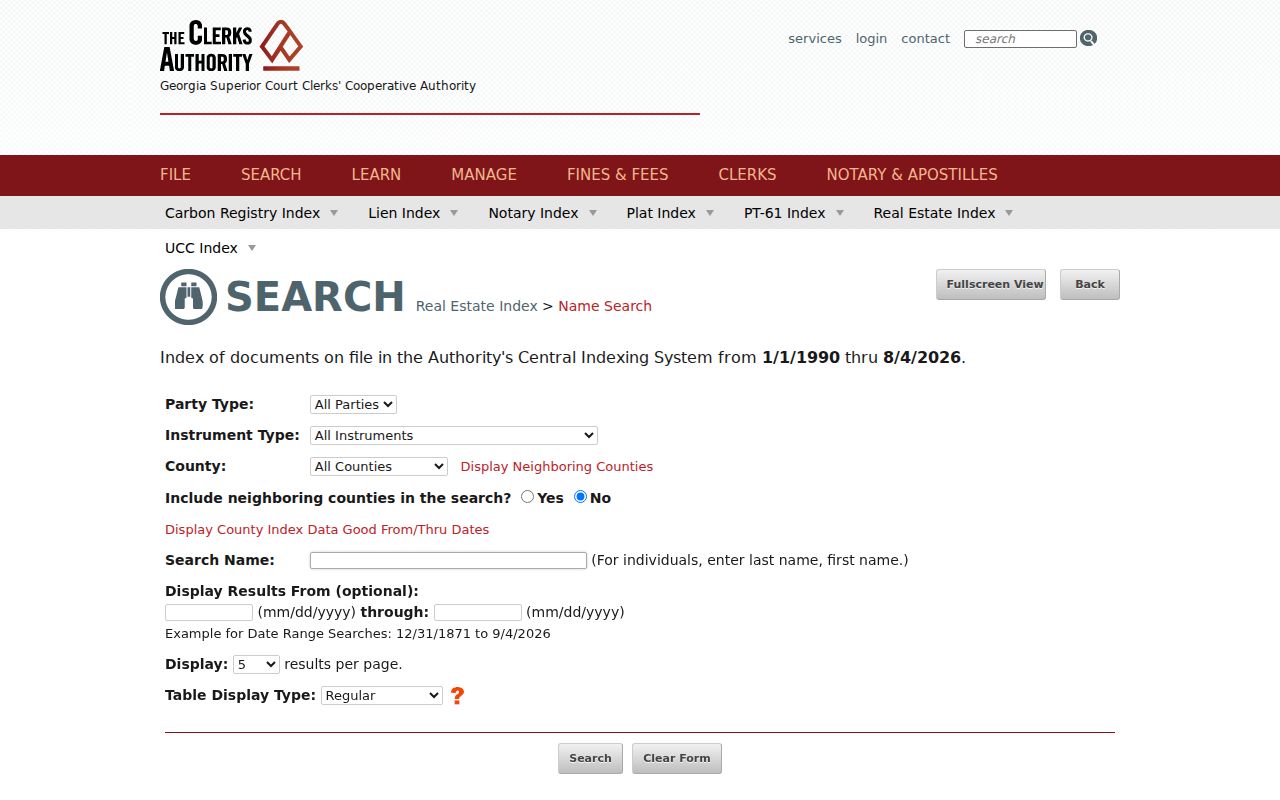
The name-search screen offers a broader date span than GSCCCA's stated all-county coverage. Treat that span as an interface setting. It is not proof that every older Bleckley deed is online. Coverage gaps still apply.
Reverse the Bleckley County Deed Chain
Open the latest deed and read the grantor's name. That party is the prior owner. Search them as grantee in an earlier period, and repeat the handoff until Bleckley County's previous owners stand rebuilt one recorded transfer at a time.
- Locate the newest purchase deed with the current owner listed as grantee. Confirm the parcel through its legal description.
- Copy the grantor's exact indexed name, the recording date, and the cited book and page.
- Search that grantor as an earlier grantee. Match the next instrument by land lot, district, acreage, or subdivision details.
- Repeat until the online run ends. Continue at the Clerk's counter, then consult the Archives county card and microfilm catalog.
- Grantor
- The party conveying an interest in the deed.
- Grantee
- The party receiving that recorded interest.
- Chain of title
- The ordered sequence of instruments linking ownership through time.
- Reverse index
- An index organized to find the grantee side of a transaction.
- Warranty and quitclaim deeds
- Different conveyance forms whose legal effect must be read from the instrument.
Book and Page Beat Name Noise
Long Bleckley County deed chains play tricks with names. Spellings drift, capitalization shifts, initials appear and vanish, and entities change form. Book and page references cut through that noise. When one deed cites an earlier instrument directly, the GSCCCA book/page search takes just the county, book, and page and lands on the exact record. The lookup screen shows that narrow three-field design.
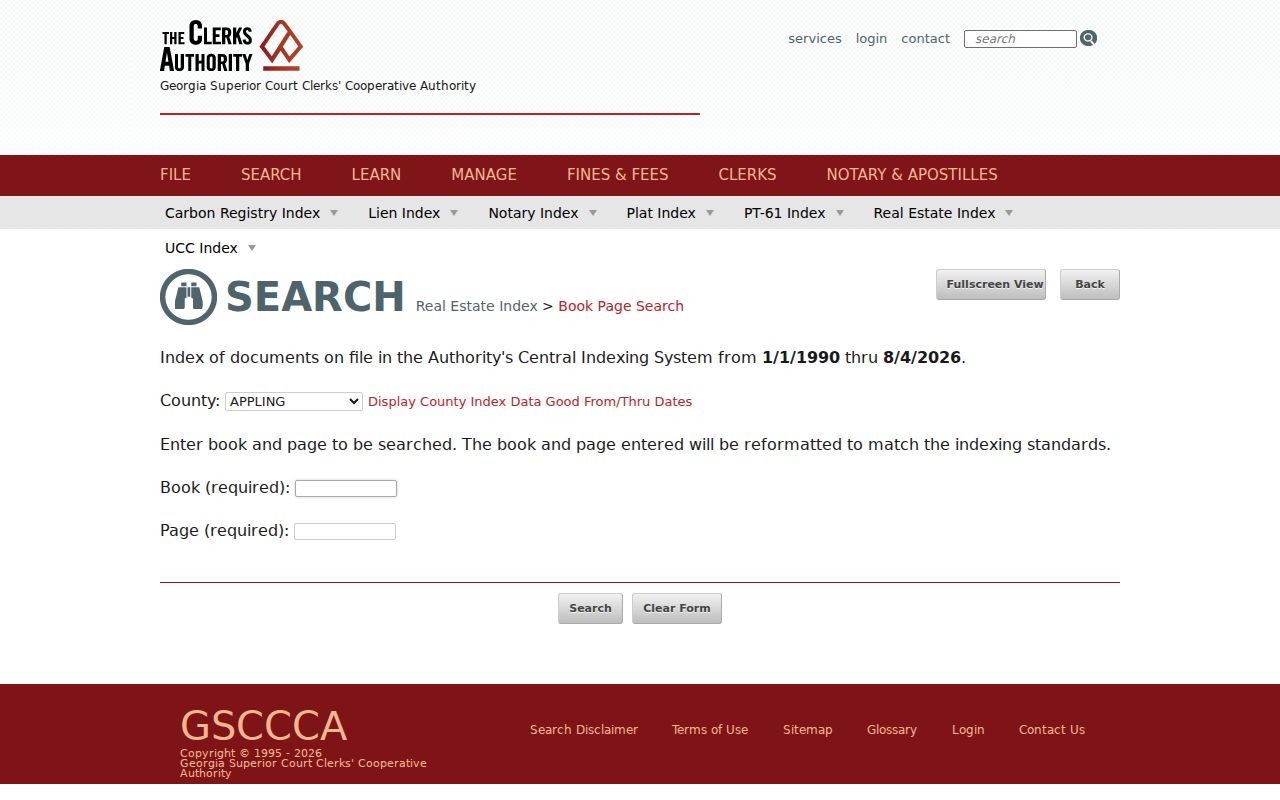
A direct book and page reference cuts same-name noise. Still, the returned instrument must match the land description, and the GSCCCA deed-index screen shows how the authority separates its real-estate search routes.
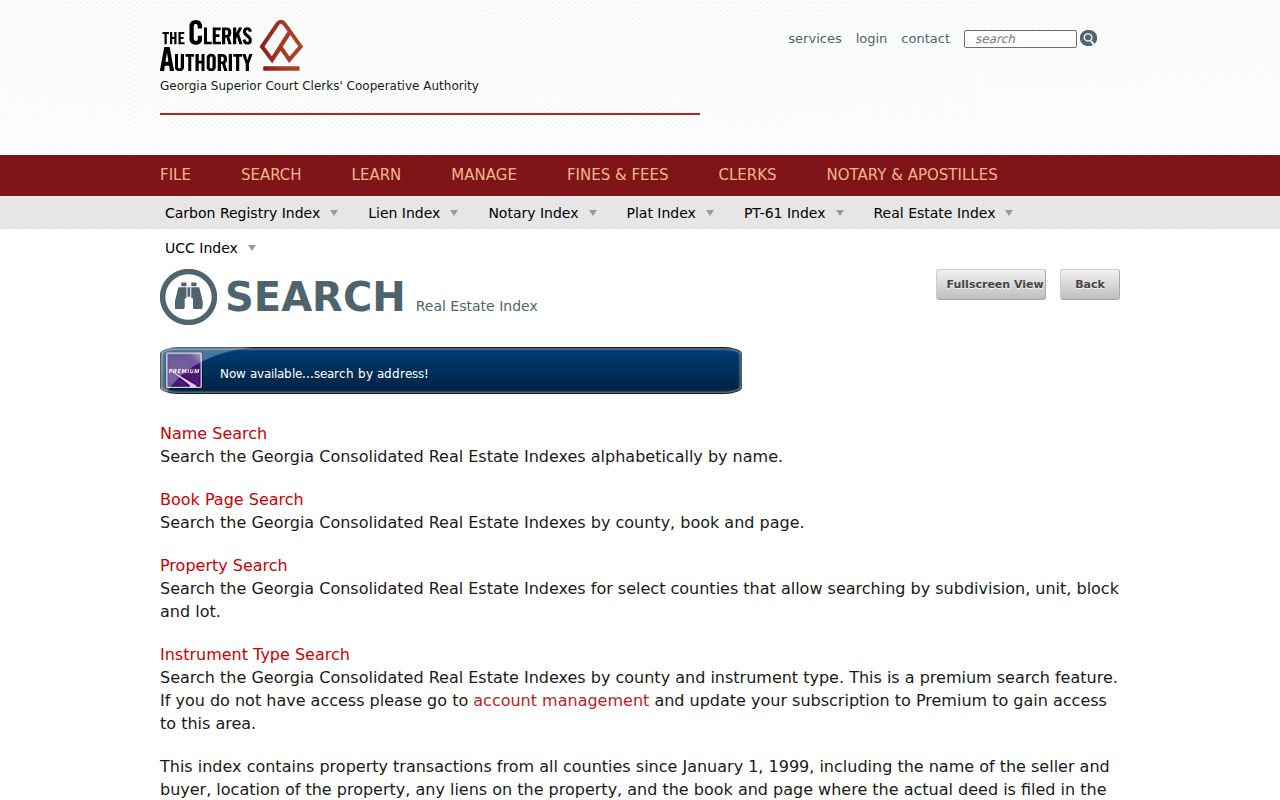
The index menu is only a starting point, not an owner history. Log each result with its date.
Older Bleckley County Owners Offline
When the web index stops, contact the Bleckley County Clerk of Superior Court at 112 N Second Street in Cochran, or call 478-934-3200. The office controls its own docket. Ask for the referenced deed book, grantor-grantee index, plat book, or permanent realty series. Staff can explain plain and certified copy options.
The Georgia Archives county microfilm collection includes deed books, tax digests, Superior Court material, and probate series. Its Bleckley card lists exact holdings. FamilySearch may provide another route to Georgia county records, sometimes through 1900. Some images require an account.
Online cutoff. GSCCCA guarantees all-county deed transactions only from January 1, 1999; confirm older Bleckley County former owners through the Clerk and archival holdings.
Probate Can Split Bleckley Chains
A chain can break when an owner dies. Probate then enters the picture. The Bleckley Probate Court says its records date to 1875 and remain in the court vault. A file may hold a will, petition, appointment, inventory, annual return, distribution order, or transfer paper.
Those papers can explain why an executor, administrator, heir, or estate appeared in the next deed. Yet a probate order is not a deed. Return to the Clerk's real-estate records. Match the estate event to the later deed. Foreclosure, partition, tax sale, corrective deed, and parcel split can also interrupt an easy chain.
Plats Reconnect Bleckley Property History
Recorded plats help when a tract became several lots. They help when the street label changed too. The GSCCCA Plat Name Search provides fields for county, plat name, survey geography, instrument, and dates. Lot, block, unit, district, land lot, easements, and adjoining owners can tie an old legal description to a current parcel.
Cochran records show how that bridge works. City minutes tied Colonial Village to a city-approved plat recorded with the county Clerk in 2012. The municipal action gives context. The recorded plat supplies the land-record reference, and a current street address alone would miss that link.
Newspapers Add Bleckley Ownership Clues
Newspapers offer clues, not title proof. Georgia Historic Newspapers lists 146 issues of the Cochran Journal from 1910 through 1913. It also lists 242 issues of The Kernel from 1930 through 1987. A subdivision notice, an estate notice, or a sale announcement can point you toward the right owner of record. An old street name can do the same. Either one may also suggest the right date to chase through the deed books.
The Tessie W. Norris Library also keeps a shelf of named Cochran and Bleckley history books in its local archive room. Ask staff for page-level references. Then confirm any ownership claim the old-fashioned way. Use the deed, probate file, plat, or tax digest.
Know Bleckley County's Proven Limit
The oldest online hit is rarely the oldest deed. Before concluding that a Bleckley County ownership chain stops, check three places: the official county card, the Clerk volumes, and the Archives catalog. The courthouse has no documented disaster on record. Nor does any surviving deed-book title claim to be the first. So treat neither assumption as fact.
Sometimes a reference simply will not match. Mark the gap honestly. Keep both sides of it on paper, noting each search form and date range you tried, and ask the custodian directly for the named series. That discipline beats stitching two similar names together with nothing behind them. To pin down today's owner of record, use the current owner record process. The backward chain starts only once that owner is confirmed.
Lawful use. Research Bleckley County former owners for house history, estate work, or property diligence. Never use owner information to track, harass, or harm a person.
Record the Evidence Behind Each Bleckley Former Owner
Log everything at every step. Keep the exact indexed name, party role, instrument type, execution and recording dates, book/page citation, legal description, and any cross-reference. When a probate, foreclosure, tax-sale, partition, or corrective document breaks the chain, label that gap. Never invent the missing former owner. A clean citation trail is what separates a proven owner of record from a newspaper, tax, or family-history lead that still needs deed records to back it up.