
Deed Types in Bleckley County
Deeds in Bleckley County are recorded by the Clerk of Superior Court. The office sits at 112 N Second Street in Cochran. A deed names the parties and spells out the interest being conveyed. Neighboring pages often hold more than deeds. Security deeds, liens, assignments, cancellations, plats, and corrective instruments all travel through the same records. Each does a different job. Read the whole trail, not just the headline transfer.
| Deed Type | What It Does | Common Use |
|---|---|---|
| Warranty deed | Conveys the stated interest with title covenants | Arm's-length transfers |
| Quitclaim deed | Conveys whatever interest the grantor has | Family or title cleanup transfers |
| Corrective deed | Repairs an error in a prior instrument | Name or description corrections |
| Executor or trustee deed | Conveys through a fiduciary role | Estate or trust administration |
| Tax deed | Records an interest arising from a tax sale | Delinquent-tax proceedings |
A Georgia security deed is not a sale. It secures a loan, plain and simple. Its later life shows up in assignments and cancellations, so follow those before drawing conclusions about ownership. Liens work differently too. A lien records a claim against the property rather than fee title. To know what really happened, read the deed image together with every related instrument around it.
Bleckley Deeds in GSCCCA
The GSCCCA Real Estate Index is the front door to Bleckley County deed research online. It covers deed, lien, plat, PT-61, UCC, and notary index families, and it supports searches by name, book and page, or property where counties participate. Start with Bleckley County. Widen the geography only when the chain or a party's history justifies it. The landing page lays out each record family and routes you accordingly, but remember it is a gateway, not the official deed itself. Open the official real-estate index to compare the record families pictured below.
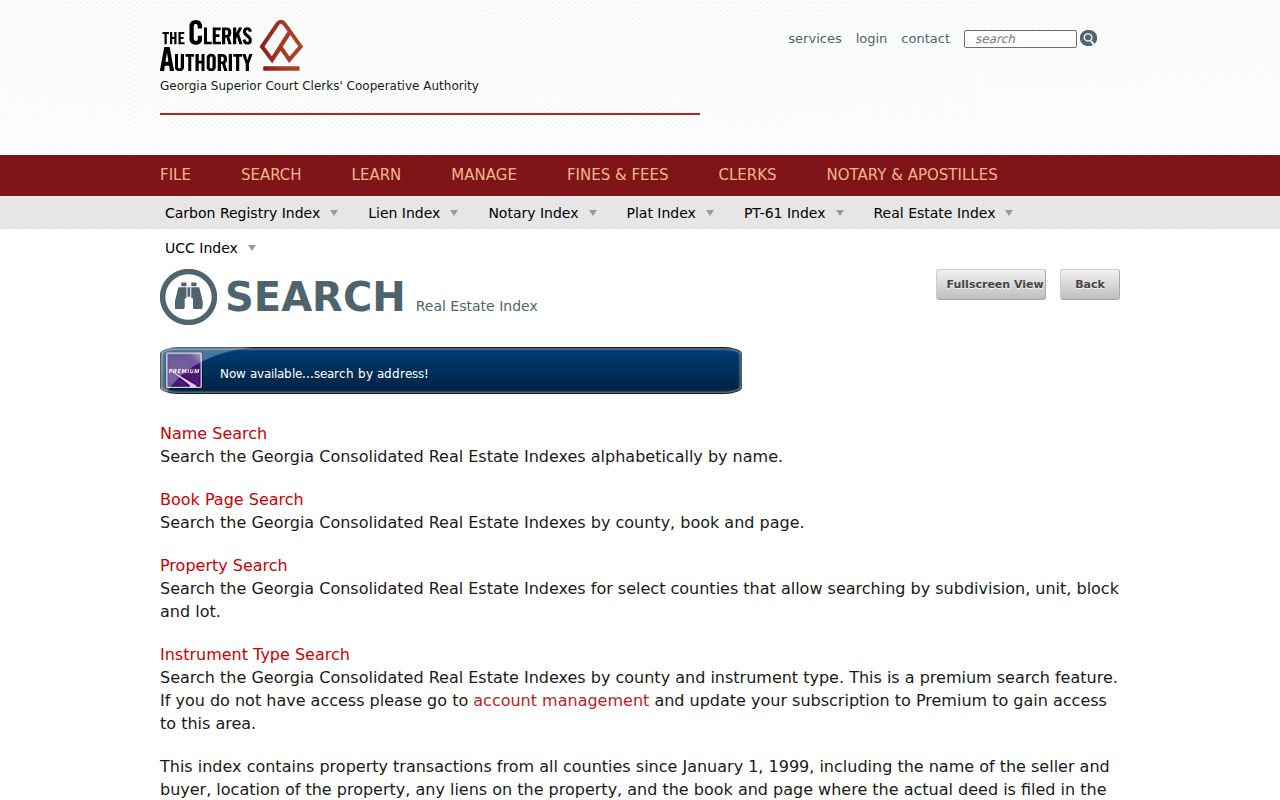
The screenshot helps distinguish deed, lien, and plat searches before a name query begins.
Search Fields for Bleckley Deeds
The deed name-search form gives you controls for party, county, date range, instrument type, neighboring counties, and how results display. Spell names exactly as first recorded. Initials and punctuation shift over the years, so expect to try variants.
| Index field | What to enter | Why it matters |
|---|---|---|
| Party name | Grantor or grantee spelling | Finds indexed transfers |
| County | Bleckley | Limits the search to the local docket |
| Date range | Likely recording period | Separates people with similar names |
| Instrument type | Deed category when known | Reduces unrelated records |
| Display controls | Rows and sort options shown | Prevents missed later pages |
View the captured GSCCCA name form before building the query.
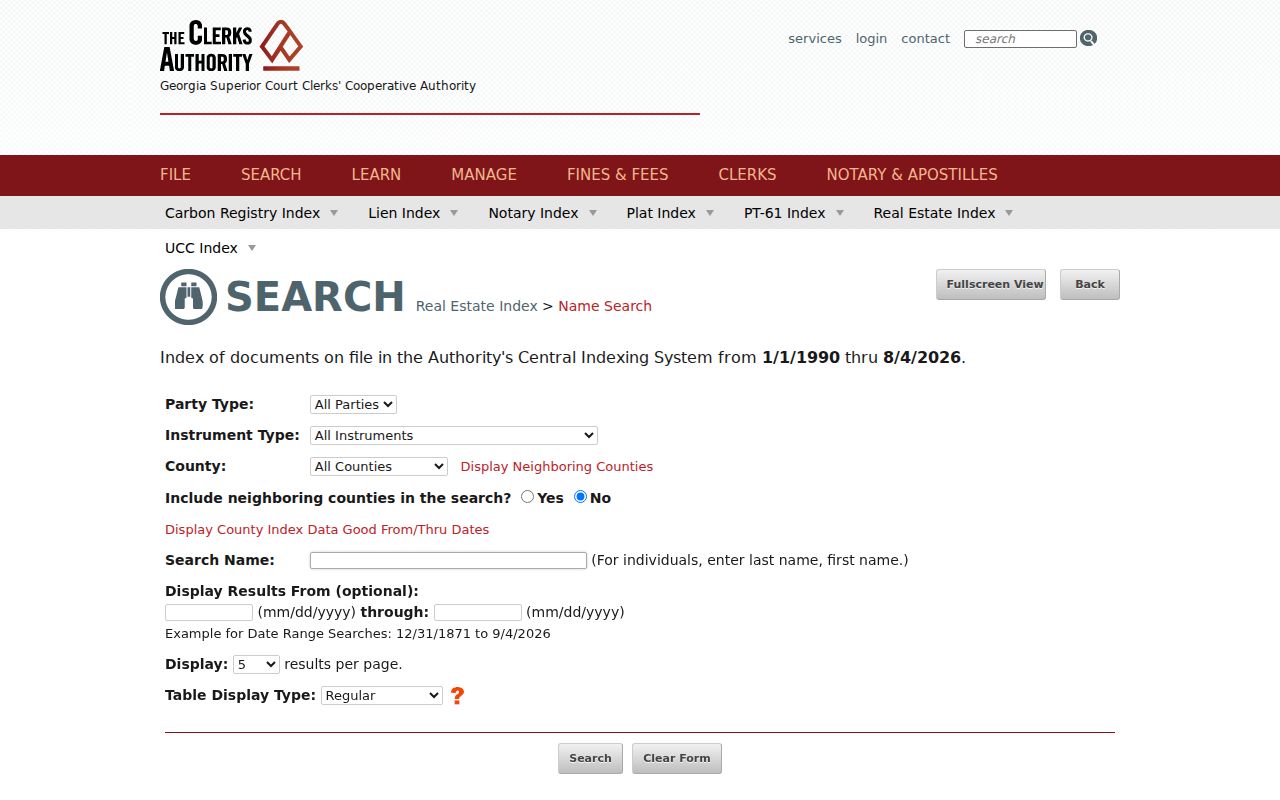
County and date choices sit right on the form. That helps when a common surname fills the screen with entries. Narrow by decade or instrument type until the list is workable.
Walk Bleckley's Grantor-Grantee Chain
A grantor gives the stated interest. A grantee takes it. Walk a Bleckley chain backward by starting with the newest deed matching the parcel's legal description, then turn that deed's grantor into your next grantee search to find the prior acquisition. Keep repeating the step. At every link, confirm that dates, acreage, land lot, subdivision, and book/page references stay consistent.
- Find the current acquisition deed with the owner indexed as grantee.
- Read the grantor, legal description, recording date, and prior book/page reference.
- Search that grantor as an earlier grantee, allowing for initials and name changes.
- Compare each description and move to deed books when online coverage ends.
- Grantor
- The party conveying the stated interest.
- Grantee
- The party receiving that interest.
- Chain of title
- The linked sequence of instruments affecting a tract.
- Book/page
- A volume and page reference used to retrieve an instrument.
- Instrument number
- A separate filing identifier assigned in the recording system.
Already holding a citation? The GSCCCA Book/Page Search asks only for county, book, and page. Enter the reference in its original format before experimenting with variations.
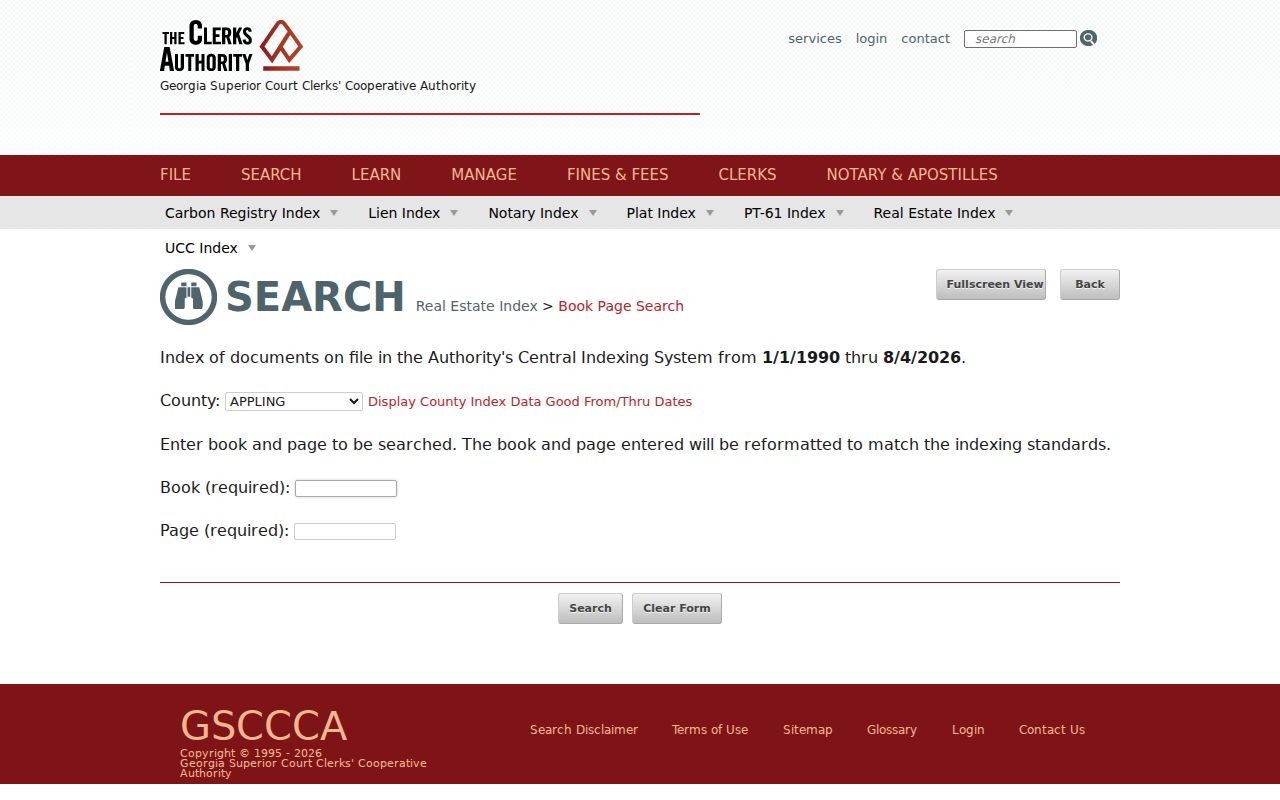
This narrow search avoids the ambiguity of a broad party-name query.
How Far Bleckley Deeds Reach
GSCCCA says all-county deed transactions run from January 1, 1999 forward. Historical data from 1993 through 1998 is being added. The name screen itself, though, displays a broader date range than that statement suggests. Treat the county good-date table and a call to the Clerk as essential checks. When the online index runs dry, ask the Clerk about grantor-grantee indexes and deed books. The Georgia Archives county microfilm catalog lists tax digests and Superior Court deed-book material. Its Bleckley card is the finding aid. FamilySearch offers another catalog route. An account is sometimes required there.
Coverage has layers. An empty online result does not prove no deed exists. Older Bleckley deed records may remain at the Clerk, on microfilm, or in bound books.
Plats Support Bleckley Deeds
A deed's legal description can point to a subdivision, unit, block, lot, district, land lot, acreage, easement, or a recorded plat. The GSCCCA Plat Name Search lets you query instrument type, county, plat name, SEC/GMD, district, land lot, and dates where available. Open the official plat-name search represented here.
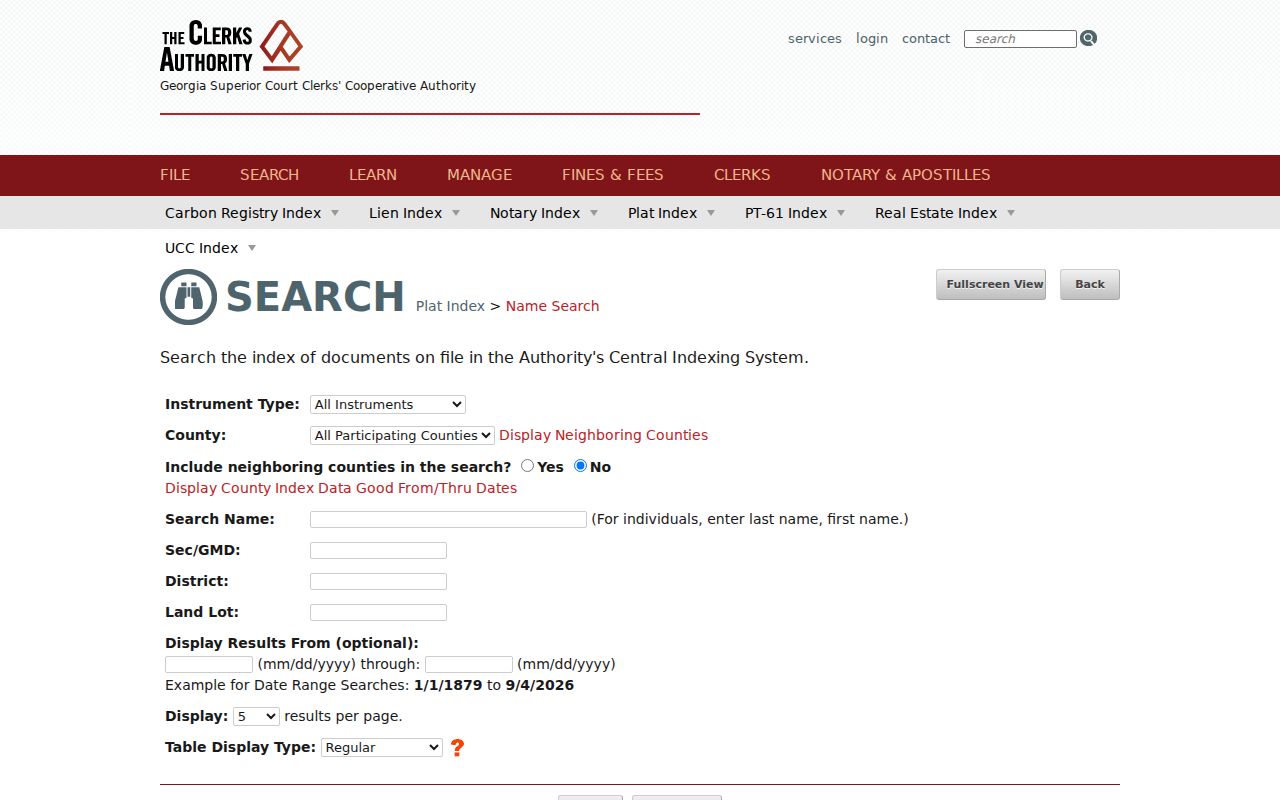
Plat fields bridge the gap between a deed's terse lot reference and the recorded map framework. Still, a current survey remains the only way to set a legal boundary on the ground.
Security Deeds and Releases
Search for security deeds, assignments, cancellations, lis pendens, liens, easements, covenants, and corrective instruments. Run these alongside the transfer deed itself. An assignment can shift the secured party. Match any cancellation or release back to the original book/page or instrument number. Check the date too, before trusting it. The GSCCCA lien name search provides party, instrument, county, date, and neighboring-county controls. Treat every result as a lead. Questions of lien priority, enforceability, or payoff are legal questions. Those belong with a Georgia attorney or title professional.
Bleckley Filing Alerts
The Filing Activity Notification System, known as FANS, sends alerts about new filing activity. It requires a login. No alert system catches every relevant event, and FANS is no exception. Georgia's Attorney General recommends it as one safeguard against title theft. It does not replace periodic review of deed records. It cannot correct a filing or settle title. If an alert looks wrong, preserve it. Contact the Clerk promptly about the official record.
Probate Breaks in Bleckley Chains
Not every Bleckley chain runs buyer to seller. Some pass through an estate. Bleckley Probate Court holds records dating to 1875, kept in the court vault. An estate file may hold a will and a petition. It may include the appointment of an executor or administrator. It may also hold an inventory, annual returns, a distribution order, or transfer paperwork. Remember that a probate order and a recorded real-estate instrument do different jobs. Search the estate name, decedent, fiduciary, and heirs as appropriate. Then return to the Clerk's deed index. Confirm there what was actually recorded against the land. The Probate Court sits at 112 N Second Street. It can explain its copy and vault-access process. Litigation can also interrupt a clean chain. Foreclosure, partition, tax sale, corrective deed, easement, and boundary litigation all break the line. Preserve the case or proceeding reference. A court-calendar entry is never the final conveyance, so treat it only as a pointer. The local case-search page sits behind a login. That makes the Clerk the practical fallback for case access.
Control Conflicting Deed Entries
The Clerk of Superior Court keeps the official deed, lien, and plat dockets for Bleckley County. GSCCCA describes its online system as informational only. When a web entry and the official index conflict, the official index wins. That rule covers several traps. Recreated historical records can carry over old errors. An image may attach to the wrong row. A party name may be misspelled, or a book and page reformatted. Check the index entry against the instrument image itself. Grantor, grantee, recording date, and instrument type should all line up. So should the legal description and any cross-references. When the image and the row disagree, note both versions and ask the Bleckley Clerk instead of picking one quietly. A certified copy reflects what the Clerk certifies from the official record. It still is not a legal title opinion. Note: Never assume the earliest web result is the oldest Bleckley deed without checking bound indexes, microfilm, and the county's official holdings.
Get a Bleckley Deed Copy
GSCCCA's published terms price online printing at $0.50 per page. Regular access runs $14.95 per month per user, with a $5 four-hour single-use option and premium access at $29.95 per month per user. Fees can change, so confirm the current service terms before you buy anything. For a plain or certified copy, contact the Bleckley County Clerk of Superior Court at 112 N Second Street, Cochran, Georgia 31014, 478-934-3200. Ask about viewing the instrument on a public terminal. Ask the page count, certification charge, accepted payment, and delivery options by mail or electronically. The office publishes no complete local copy-fee schedule.
Recorded, not guaranteed. Bleckley County deed records show what reached the recorder. They do not guarantee clear title, resolve unrecorded interests, or provide a title opinion.
A written Georgia Open Records request can ask for existing electronic index entries or images. Specify party names, a date range, the legal description, and any known book and page. The request cannot force the office to build a new chain-of-title report. Weigh plain against certified copies before ordering. A plain image suits personal property-history research. It can help you spot the next book reference. A certified copy is the Clerk's attested reproduction. It is often required for a filing or formal proceeding. Name the exact instrument and the number of copies. State whether certification is needed and your preferred delivery method. That detail lets the office quote the right charge. Keep the whole retrieval chain with your copy: the index query, the result row, the image, the source URL, and the access date. A margin notation or cross-reference may be part of the instrument itself. A legal-description exhibit or attached plat may be part of it too. Count those pages too. A missing attachment can strip out the detail that ties the deed to the parcel.
Always reconcile a short index hit against the recorded image or a Clerk-certified copy before relying on the conveyance.